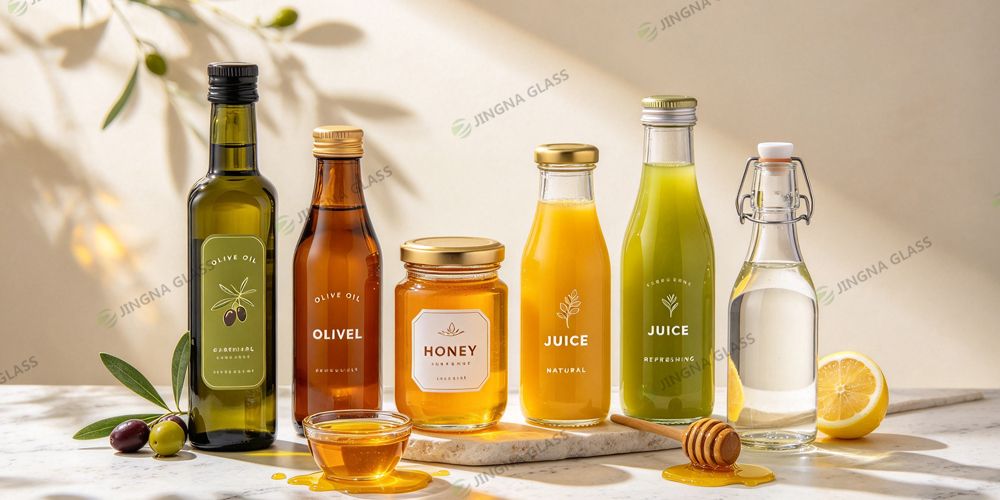
Many foreign trade purchasers tend to mistakenly believe that all glass bottles can directly hold edible oil, fruit juice and honey. In fact, this is not the case. The core prerequisite for food-grade glass bottles is the compliance of raw materials. The mainstream uses sodium-calcium crystal white glass. Raw materials such as sand and gravel, soda ash, and limestone all need to meet the food contact raw material standards. Lead-containing crystal glass is strictly prohibited from being used for food filling to avoid the risk of heavy metal leaching. Guangdong Province, Zhanjiang... .
Different types of food have different requirements for the selection of glass. Juice is an acidic drink. Long-term storage is more likely to cause substance migration. It is recommended to use crystal white materials with better chemical stability first. Olive oil has a high light-blocking requirement. The tea-colored amber glass can block ultraviolet rays and delay the oxidation of the oil. Honey has a high viscosity and often requires hot filling. The bottle body must be fully annealed to reduce internal stress and prevent thermal shock cracking.
At the same time, attention should be paid to the risks of deep processing techniques. Spraying, baking, silk-screen printing inks, and metal decorative coatings all fall under the category of indirect food contact materials. Decorative pigments must meet migration limits and inferior colorants containing lead and cadmium must not be used. In many cases of non-conformity in export orders, it is not the glass itself but the surface decorative layer that exceeds the standard.
The domestic basic standard is GB 4806.5. For export to the United States, it needs to meet the FDA 21 CFR food contact requirements, with a focus on controlling the leaching of heavy metals such as lead and cadmium. When making purchases, in addition to checking the material certificates, it is also necessary to confirm the factory's production control. Refuse to recycle products with an unclear proportion of waste materials and no batch inspection reports, and ensure the safety bottom line of export packaging from the source.