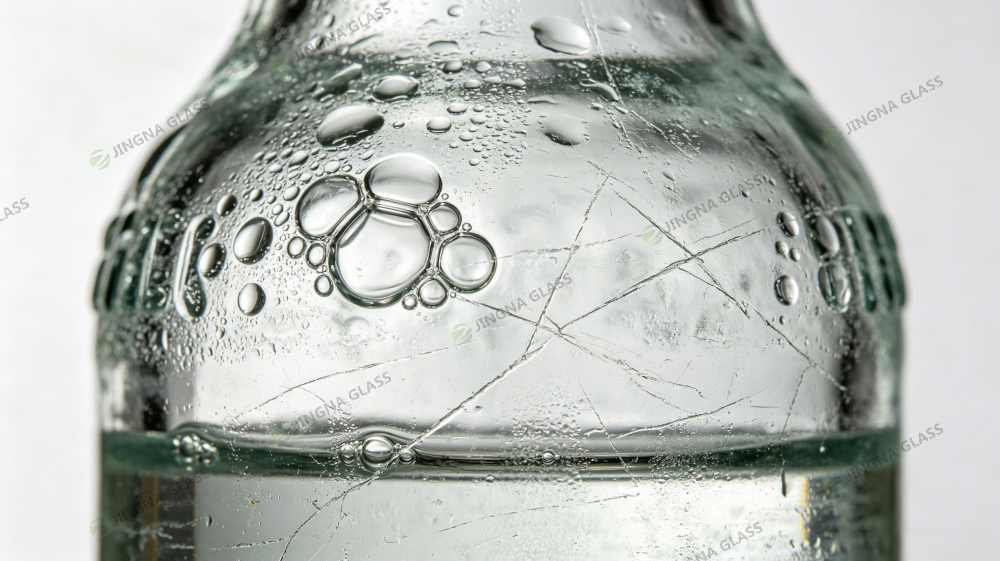
Bubbles and scratches are the most common appearance defects in glass bottle production, directly affecting the pass rate and performance in use. According to data from the glass container industry, the defect rate caused by surface defects accounts for approximately 35% to 50% of the total defective products, among which bubbles and scratches account for over 70%. The melting process is the source of bubble formation. Insufficient clarification of the glass liquid, residual gases, impurities carried by raw materials and contaminants from broken glass can all form visible bubbles. Uneven temperature in the kiln and poor convection of the material liquid will intensify the aggregation of micro-bubbles. Bubbles with diameters ranging from 0.3 to 0.5mm are restricted in both food and cosmetic bottles, and those exceeding 0.5mm are often judged as substandard. During production, bubbles often occur in batches due to material temperature fluctuations exceeding ±10℃ and insufficient clarification time. The formation and mold factors dominate the generation of scratches. The positioning deviation of the blank when entering the initial mold and the intense friction with the mold wall are prone to cause creases and scratches. The mold material has insufficient density and oxidizes quickly at high temperatures, making it prone to micro-concave points on the surface and causing the bottle body to be rough and not smooth. Poor lubrication of the mold, uneven oil spraying or poor-quality oil will increase friction, and unstable dripping speed will also aggravate surface damage. Equipment parameters are as crucial as operation. If the speed of the row-column machine is too fast or too slow, it will cause uneven thickness of the bottle body and the appearance of spots. Improper debugging of the air nozzle and the feeding machine leads to an imbalance between the initial mold and the final mold temperatures, resulting in cold spots and a reduction in surface finish. Excessive cut marks and unreasonable initial mold design will leave obvious scars and color spots on the bottle body. Controlling defects requires starting from multiple links: stabilizing the kiln temperature and clarification process to ensure the purity of the glass liquid; Select high-temperature resistant and high-density mold materials and carry out regular polishing and maintenance. Optimize the weight of material droplets and the accuracy of material dropping to reduce friction; Standardize the machine speed, air pressure and lubrication parameters to maintain a stable molding temperature. After implementation, the defective rate of bubble scratches can be reduced to within 2%, significantly enhancing production efficiency.