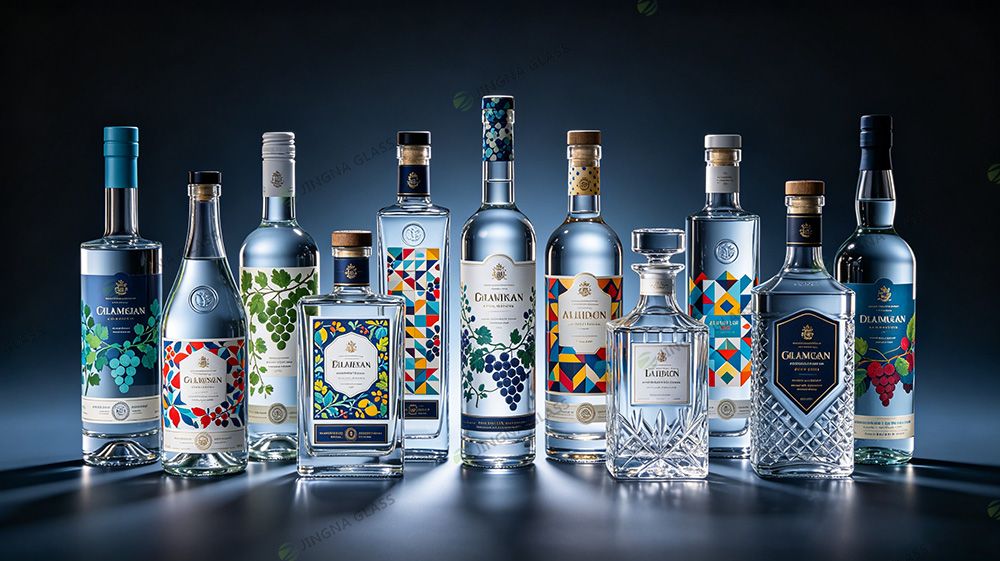
Glass bottle embossing is the mainstream process in packaging decoration, which is divided into high-temperature embossing and low-temperature embossing. The two have significant differences in firing conditions, appearance effects, and applicable scenarios. Low-temperature baking paper with small film is mainly based on oil-based ink. The baking temperature is 150-180 ℃, and some can be directly attached without baking. It has bright colors, high gloss, strong three-dimensional effect, is wear-resistant, corrosion-resistant and environmentally friendly. The process difficulty is relatively low, but due to the slow drying of the ink, the production cycle is longer. Its advantages lie in its affordable cost, its ability to achieve rich colors that are difficult to present at high temperatures, its compatibility with most bottle types and process combinations, and its gradual replacement of traditional high-temperature decorative paper as the mainstream choice in the market.
The high-temperature baking temperature reaches 540 to 600℃, and this range is commonly used for overglaze high-temperature decorative paper. Underglaze or high-temperature glaze firing can reach 1000-1250℃, and is mostly used for daily-use porcelain, with less application in wine bottles. High-temperature decorative paper has better adhesion, and the patterns are durable and wear-resistant. They will not fall off or fade even after long-term storage. However, the materials used at high temperatures often contain precious metals, which makes the cost relatively high. The color development is more stable and not as vivid as that at low temperatures. It is difficult to fully display the color gradation of colored glaze bottles when they are baked at high temperatures. High-temperature processes have strict requirements for temperature control and are prone to problems such as burst patterns and uneven color development. For gold-containing decorative surfaces, temperature control is even more crucial. For glass, it is recommended to operate at 540-560℃, while for ceramics, 750-780℃ offers the best stability.
The two processes of decal application are similar to the preservation of decorative paper, with the core difference lying in the firing temperature. For durability, longevity and stable quality, choose high temperature. When it comes to color, cost, delivery time and flexible adaptability, choose low-temperature options. In actual customization, only by choosing based on product positioning, usage scenarios and budget can both aesthetics and practicality be balanced.