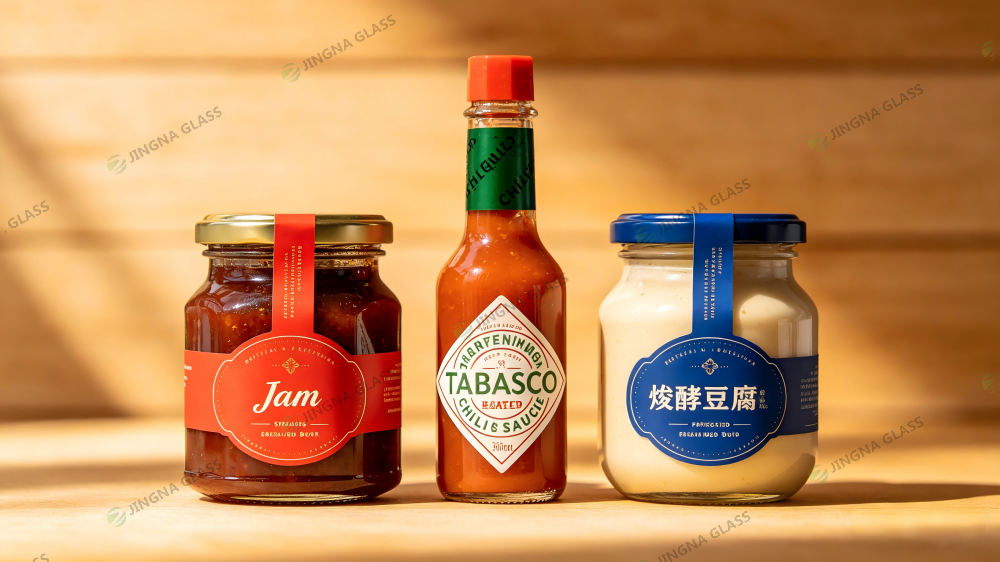
Glass bottles are a classic choice for food packaging and are widely used in condiments and side dishes such as jam, chili sauce, and fermented bean curd. Many people think that these types of bottles look similar, but in fact, there are obvious differences in structural design and usage scenarios. Choosing the wrong one not only affects usage but also is not conducive to product preservation and display.
Jam bottles are mainly characterized by their transparency and aesthetic appeal. They are mostly wide-mouthed round or square bottles. The bottle bodies are transparent and smooth, making it easy to clearly see the color and texture of the jam and enhancing the desire to purchase. The bottle mouth has a relatively large diameter, making it convenient to scoop out with a spoon. It can be paired with a screw cap or a flip cap to ensure convenient daily use and no leakage. The jam is slightly sweet and has a moderate acidity. It has a moderate requirement for the corrosion resistance of the bottle. The focus is on the appearance and ease of use. It is suitable for low-temperature storage and simple high-temperature disinfection. It is also easy to clean after repeated use.
The chili sauce bottle places more emphasis on acid and salt resistance as well as strong sealing. Chili sauce contains components such as chili peppers, salt, and vinegar, and is highly corrosive. It is required that the bottle body has high chemical stability, not reacting with the sauce to prevent flavor changes or the release of harmful substances. The bottle shapes are mostly narrow-mouthed or conical at the end, which is convenient for controlling the amount poured out and preventing too much from being poured at one time. The bottle caps are commonly anti-theft screw caps or silicone sealing caps, which have a higher sealing grade to prevent oil leakage, gas leakage and odor mixing. Some chili sauce bottles will be thickened to enhance their compressive strength, adapt to transportation and high-temperature sterilization processes, and be more durable.
The fermented bean curd bottle focuses on fermentation compatibility and stability. Fermented bean curd is made through fermentation. During its storage period, it requires a stable environment. Generally, the bottle body is thick and the bottom is wide, making it stable when placed and less likely to tip over. The bottle mouth is of moderate size, which not only allows for the smooth placement of fermented bean curd blocks but also ensures a tight seal to prevent contamination by miscellaneous bacteria. Many fermented bean curd bottles come with inner LIDS or sealing gaskets for dual protection, maintaining the micro-environment inside the bottle and extending its shelf life. The bottle bodies are mostly simple and practical, emphasizing durability and safety. The transparency requirement is lower than that of jam bottles, and more emphasis is placed on the fermentation protection function.
At present, many manufacturers allow the three bottle types to be used interchangeably in order to save costs. However, with the upgrading of consumption, the differences are becoming increasingly obvious. Jam bottles are developing towards being more delicate and compact with a higher level of appearance, chili sauce bottles are strengthening their leak-proof and anti-corrosion structures, and fermented bean curd bottles are optimizing their fermentation adaptation designs. Professional packaging can enhance the texture of the product and also make its use more reassuring.
There is no need for complicated detection to distinguish the three. Remember three points: look at the size of the bottle mouth and the way to take it, look at the grade of the sealing structure, and look at the thickness of the bottle body and its purpose. In daily procurement or production, matching the corresponding bottle type according to the characteristics of the food can not only ensure quality but also enhance the brand image, allowing the glass bottle packaging to maximize its value.