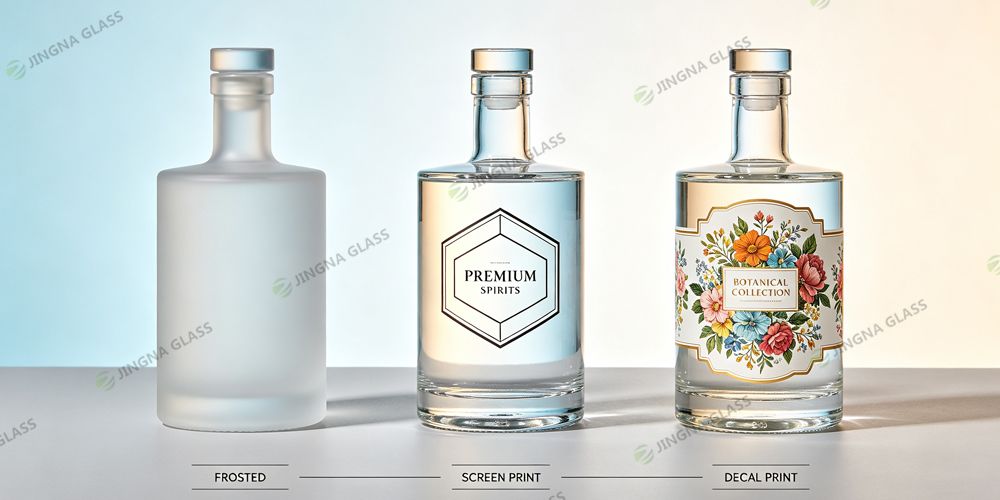
To create a distinctive appearance for custom glass bottles, the surface decoration process is crucial. Frosted glass, screen printing, and decal printing are the most mainstream choices in foreign trade packaging orders. Wineries and food sauce brands often compare these options.
The acid frosted process is to create a uniform and fine matte effect on the bottle body through acid etching treatment, with a soft touch and a naturally high-end and understated texture. Frosted surface treatment is a one-piece formed surface treatment. The pattern is a matte finish throughout the bottle, which is not easy to be scratched, resistant to alcohol and water washing, and suitable for high-end products such as spirits and essential oil bottles. The disadvantages are that it cannot create fine gradient patterns, the minimum order cost is relatively high, and the color options are relatively limited.
Screen printing, also known as silk screen printing, directly prints ink onto the surface of glass bottles and then cures it through high-temperature baking. It can be made with single-color or few-color logos and simple text. It has strong adhesion, is wear-resistant and scratch-resistant, and is not prone to paint peeling during long-term storage. The delivery time is stable and it is suitable for large-scale standardized orders. The drawback of screen printing lies in its difficulty in achieving complex color images. The more colors are overused, the higher the cost and the higher the defect rate will be.
Decal printing, also known as flower paper labeling, first prints the complete pattern on water transfer printing flower paper and then transfers it to the bottle body, which is baked to fix the color. The greatest advantage of this process is its strong expressiveness. It can reproduce colorful patterns, gradients, and complex illustrations, and the fineness of the patterns far exceeds that of screen printing. Its unit price has a significant advantage in the small-batch sample stage, but its durability is weaker than that of silk-screen printing and sandblasting. Long-term repeated friction and soaking are more likely to cause lifting and wear at the corners.
From the perspective of cost ranking, under normal conditions: decal < silk-screen < acid frosted. If you are pursuing long-term durability and a simple logo, silk-screen printing is preferred. If you want a matte and high-end texture, choose frosted. If you need rich color images and control the cost of sample-making, decals are more suitable. When foreign trade customers place orders, they also need to comprehensively determine the process based on the product usage environment, export certification requirements, and MOQ to avoid problems such as peeling and fading in the later stage.