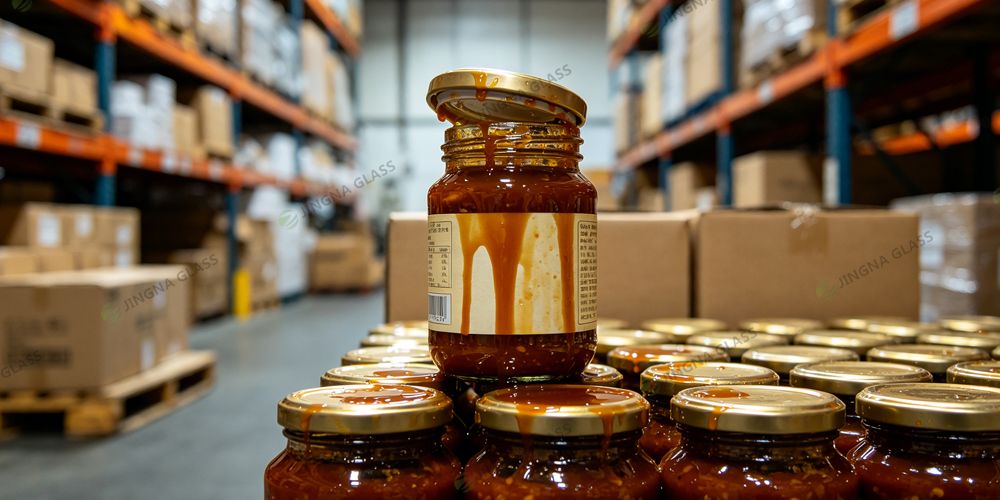
On the market, after vacuum sealing and filling of glass bottles for pickles, fruit juice and seasonings, problems such as leakage and the safety button of the bottle cap bouncing back and swelling often occur. Many merchants mistakenly believe that it is due to a mistake in the capping process, but in fact, most of the faults are caused by production defects of the glass bottles themselves. Formal glass bottle production has strict standards for the flatness and integrity of the bottle mouth. Once the forming process is not properly controlled, it will directly leave a hidden danger of leakage.
The first type of common defect is that the bottle mouth is out of round and the surface is not smooth. During the glass blowing and molding stages, mold wear and improper demolding operations can cause the edges of the bottle mouths to become uneven and elliptical. Even if the standard metal cap is tightened, the bottle mouth and the sealing ring cannot fit completely. The internal vacuum environment will leak slowly. In the short term, no abnormality can be seen, but after a few days of storage and transportation, oil seepage and soup leakage will occur, and the loss rate of the finished product will increase significantly. This kind of defect is difficult to distinguish roughly with the naked eye. It is necessary to use a caliper and light to conduct a comprehensive inspection of the circumference of the bottle mouth.
The second type of highly concealed hidden danger is the cold burst mark on the bottle mouth. During the cooling stage of the glass, if the temperature difference is too large, fine cracks will occur on the inner side and edge of the bottle mouth. The cracks are extremely fine and are hard to detect under ordinary natural light. They can only be found when illuminated from the side with strong light. After the vacuuming of the pickled vegetables is completed, the safety button of the bottle cap will initially sink normally, seemingly sealing properly. However, after being stored for one night or transported for a short distance, the crack will slowly allow air to enter, the vacuum will fail, the safety button will automatically pop up, and the sauce and oil will seep out through the gap. The entire batch of products will be directly scrapped.
Some small glass processing factories, in order to cut costs, skip the full inspection process before leaving the factory. As a result, defective products with cracked or deformed bottle mouths flow into food processing factories, causing economic losses and reputation risks to the brands. When food production enterprises purchase glass bottles, they need to establish a random inspection mechanism for incoming materials. They should use strong light to check the integrity of the bottle mouth, remove deformed or cracked defective products, avoid leakage problems from the source, and reduce after-sales losses.